Project Glass is being developed by Google X Lab, which has worked on other futuristic technologies such as self-driving cars. The project was announced on Google+ by Babak Parviz, an electrical engineer who has also worked on putting displays into contact lenses; Steve Lee, a project manager and "geolocation specialist"; and Sebastian Thrun, who developed Udacity as well as worked on the self-driving car project. Google has patented the design of Project Glass.[10]
All of them are top quality sets. Actually this is a war between IOS and Android. no doubt Android has destroyed the IOS, symbian, windows markets. Iphone 5 so much costly as compared to others. I have done some survey and checked myself. People have different opinions.
First thing is the body. No doubt HTC sets are so solid and are very beautiful in shape. So, this goes for HTC. Second is Apple's iphone and third is Samsung because of its non-scratchless body.
Now comes the processor, both Androids have quad core processor. HTC has 1.7Ghz, Samsung has 1.4Ghz, IPhone has A6 Dual core 1.2Ghz. Again HTC won.
Now comes the camera, which no doubt Iphone wins. There is no match for the details of the picture of iphone then HTC and then Samsung.
Now the Software, Android has more flexibility and HTC's Sense add more flexibility to users. On the other hand Samsung has its default Android Software and IOS has its default too.
Due to multiple cores Apps runs pretty fine on all sets. But Apps on Iphone runs smooth/better than Android becuase there are too many sets for Android developers to optimize the application.
Everyone's eyes on this wonderful Android set. Very slim, large screen, eye sensor, many more things. Set is so much delicate this can be compliment or a drawback. Body same as S2, not scratch less. Nice finishing, slightly igger in hand to use. Overall a wonderful set to use.
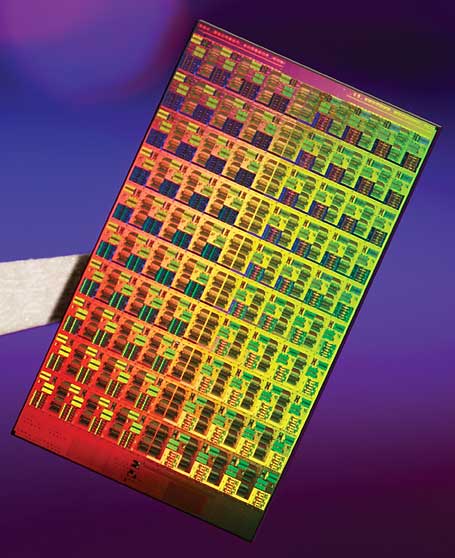
Photograph: Courtesy of IntelIf your CPU has only a single core, it's officially a dinosaur. In fact,quad-core computing is now commonplace; you can even get laptop computers with four cores today. But we're really just at the beginning of the core wars: Leadership in the CPU market will soon be decided by who has the most cores, not who has the fastest clock speed.
What is it? With the gigahertz race largely abandoned, both AMD and Intel are trying to pack more cores onto a die in order to continue to improve processing power and aid with multitasking operations. Miniaturizing chips further will be key to fitting these cores and other components into a limited space. Intel will roll out 32-nanometer processors (down from today's 45nm chips) in 2009.
When is it coming? Intel has been very good about sticking to its road map. A six-core CPU based on the Itanium design should be out imminently, when Intel then shifts focus to a brand-new architecture called Nehalem, to be marketed as Core i7. Core i7 will feature up to eight cores, with eight-core systems available in 2009 or 2010. (And an eight-core AMD project called Montreal is reportedly on tap for 2009.)
After that, the timeline gets fuzzy. Intel reportedly canceled a 32-core project called Keifer, slated for 2010, possibly because of its complexity (the company won't confirm this, though). That many cores requires a new way of dealing with memory; apparently you can't have 32 brains pulling out of one central pool of RAM. But we still expect cores to proliferate when the kinks are ironed out: 16 cores by 2011 or 2012 is plausible (when transistors are predicted to drop again in size to 22nm), with 32 cores by 2013 or 2014 easily within reach. Intel says "hundreds" of cores may come even farther down the line.
The Airbus Concept Cabin points to the future of air travel
Airbus engineers have outlined their vision of what passengers could expect from air travel circa 2050 - and it sounds like a lot more fun than today's cattle class experience. The Airbus Concept Cabin focuses on high levels of customization tailored to suit individual needs including auto-morphing seats and personalized entertainment. Passengers' body heat would also be harvested via the use of smart materials that integrate the electrical system and do away with the need for conventional wires.
The Concept Cabin is an extension of the company's future plane design first canvassed last year. The transparent plane design would be lightweight, bird-bone-like structure, covered by bionic skin membranes.
Once on-board, a passenger would simply touch the wall to be identified by the plane's "neural network" which would then track the person and enable the auto-morphing seats, personalized digital access and automatic responses to personal needs.
Instead of traditional cabin classes, Airbus sees the aircraft interior as being divided into a number of zones. The "Vitalizing Zone" would cater for relaxation and well-being with massage and acupressure-enabled seats, antioxidant enriched air, mood lighting and a panoramic view of the sky. There would also be a "Smart Tech Zone" and an "Interactive Zone" which would imitate any possible social scene, meaning passengers could arrange a virtual business meeting, play a game of virtual golf, go virtual shopping, or read a bedtime story for their kids back at home.
The cabin would also be 100 percent recyclable and feature self-cleaning materials made from plant fibers.
"Our research shows that passengers of 2050 will expect a seamless travel experience while also caring for the environment," says Charles Champion, Airbus Executive Vice President Engineering.
The company says some of the Concept Cabin technologies are already in the development phase and the ideas presented in the concept will influence future designs.
The Airbus Concept Cabin project is to be showcased during the up-coming 49th International Paris Air Show (20 - 26 June, 2011) in the form of a 360-degree planetarium movie - we'll be sure to stop by for a closer look.
Airbus provides an overview of the 2050 plane in the following video: